Hybrid model
LinearMHDVlasovPC
Hybrid linear MHD coupled with energetic ions (6D Vlasov) via the pressure-coupling scheme.
Overview
LinearMHDVlasovPC is the pressure-coupling counterpart to the
current-coupling hybrid model. It is targeted at linear problems where energetic-particle pressure anisotropy is the relevant feedback channel on the bulk MHD dynamics.
Use cases
This model is appropriate for:
- linear pressure-coupling hybrid studies
- energetic-particle pressure feedback on MHD modes
- verification of PushEtaPC and pressure-coupling operators
Governing equations
PDEs solved by model:
MHD continuity:
MHD momentum:
MHD pressure:
MHD induction:
Energetic-particle Vlasov equation:
Perpendicular pressure tensor:
Normalization
Fluid and hot-particle velocities are normalized with the bulk Alfvén
speed. The kinetic pressure tensor is scaled consistently with , and the hot cyclotron parameter is .
Discretization
Time integration is performed by the following propagators (in sequence):
Diagnostics
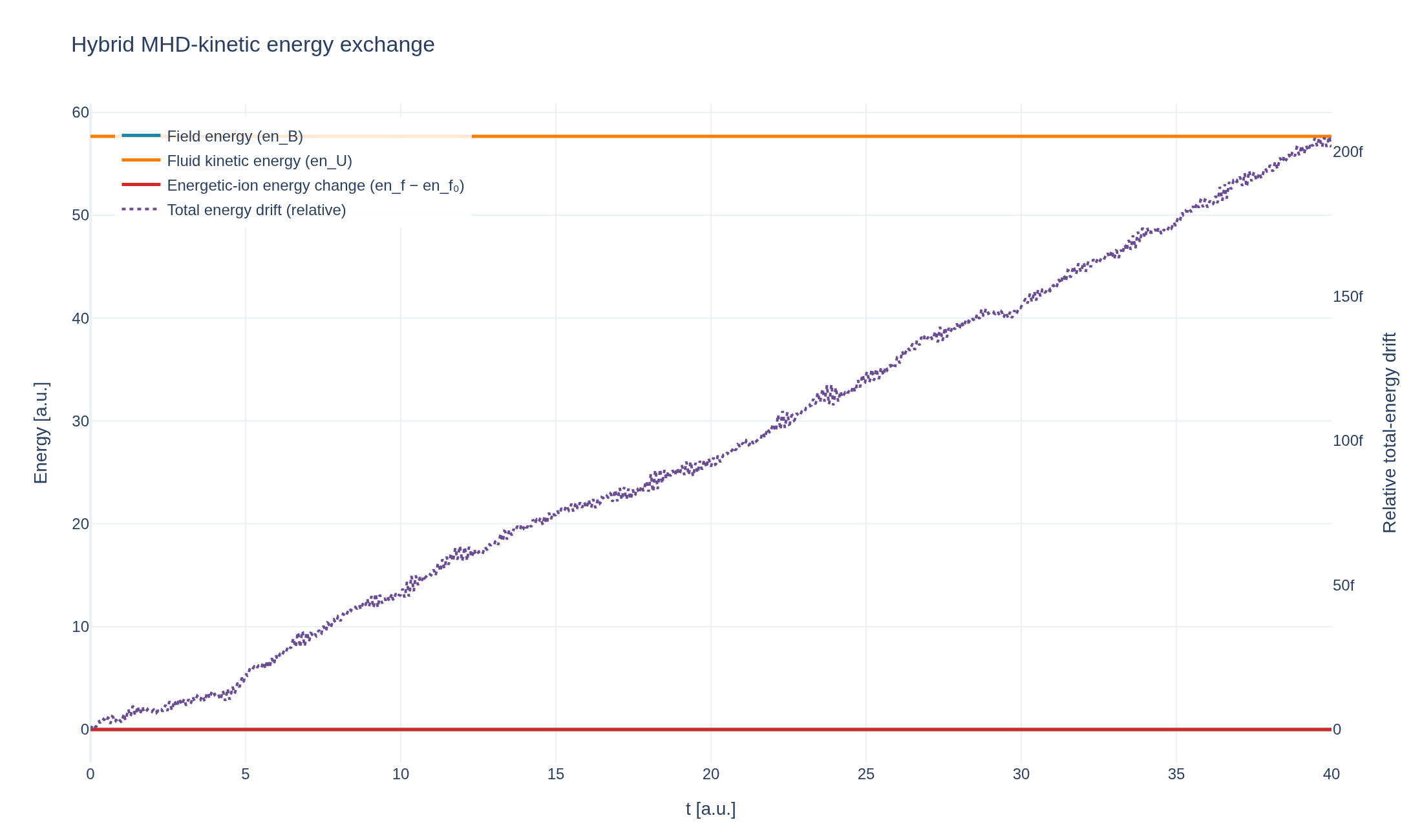
The following scalars are tracked during simulation:
- MHD kinetic energy:
en_U - Thermal pressure energy:
en_p - Magnetic energy:
en_B - Energetic-particle kinetic energy:
en_f - Total energy:
en_tot - Lost particles:
n_lost_particles