Struphy studies

Numerical studies with Struphy: convergence studies, verifications and comparisons of models and discretizations. Each study lists its runs with the parameter files and commands to reproduce them, and shows the figures and videos of every run.
-
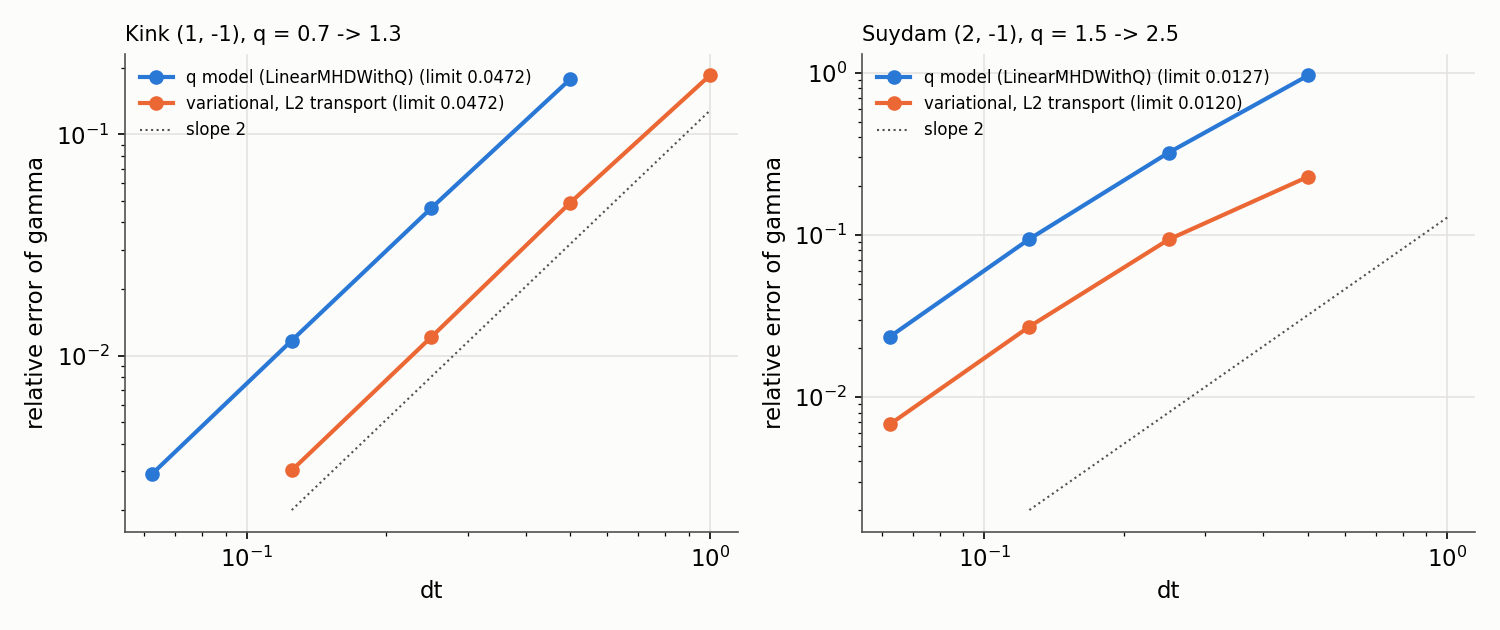
Relative error of the growth rate of the kink (left) and of the Suydam mode (right) against the time step, both models, exact eigenvalues of the one-step map
Linear MHD on polar splines: q model vs. variational p model
@nicolominichelli · 2026-11-17 ·
1f5424dddOn polar splines, the variational linear MHD model with L2 transport projections gives the same instabilities as the q model, converges about four times faster in the time step, conserves its energy to round-off and has no time-step-induced growing modes, at about twice the cost per unit time at equal accuracy; both models share a static grid-scale instability at the shortest axial wave when the number of axial elements is even.
-
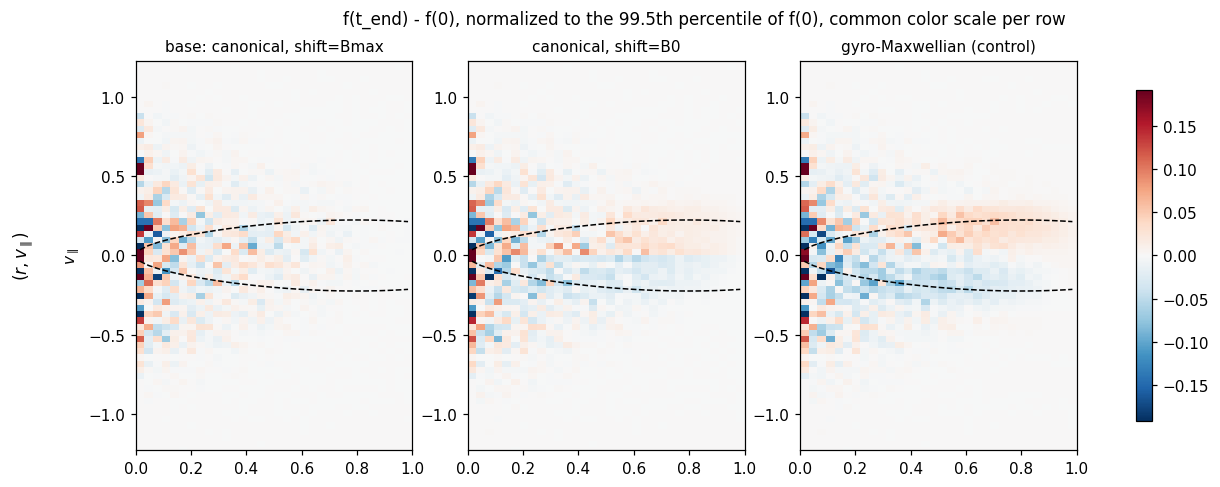
Change f(100) - f(0) of the guiding-center distribution in (r, v_par): exact canonical Maxwellian (left), on-axis shift B0 (middle), gyro-Maxwellian control (right)
Canonical Maxwellian equilibrium of guiding centers in a tokamak
@spossann · 2026-11-14 ·
e0351a835A canonical Maxwellian of guiding centers in an ad hoc tokamak stays stationary up to t = 100 to the level of the Monte-Carlo noise with all three pushers, while a gyro-Maxwellian control and a canonical Maxwellian with the on-axis shift develop a parallel-velocity asymmetry from the radial shift of the passing orbits.
-
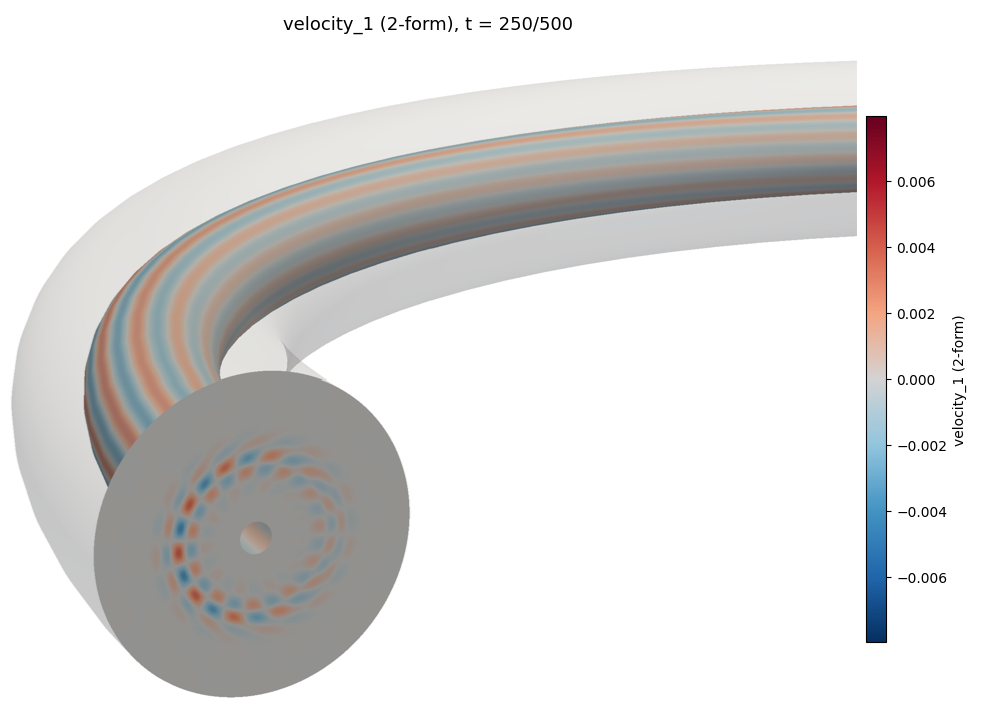
Run hcurl_24x88x8: radial velocity (first component of u in the 2-form basis) at t = 250, 3D cutaway with the flux surface r = 0.5 of the gap
ITPA TAE with ShearAlfven: magnetic field in H(curl) vs H(div)
@spossann · 2026-11-12 ·
b93810444The ShearAlfven model reproduces the n = 6 TAE of the ITPA benchmark within 1.5-3% of the ideal MHD frequency with the magnetic field in H(curl) on 24 x 44 x 8 and 24 x 88 x 8 elements and in H(div) on 24 x 88 x 8; H(div) conserves the energy exactly but needs the finer poloidal grid, H(curl) damps numerically, strongly on the coarse grid.
-
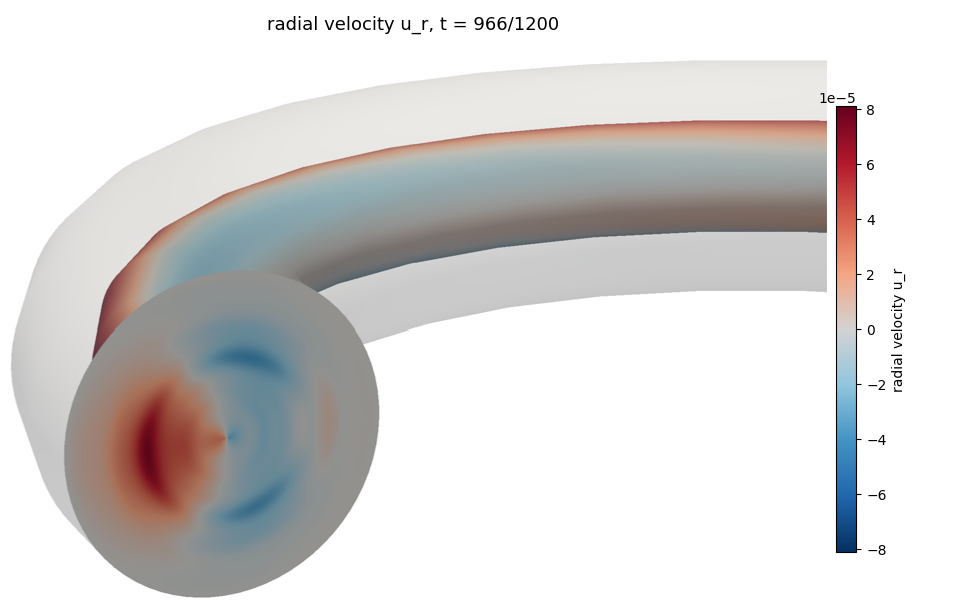
Run polar: radial velocity u_r at t = 966, 3D cutaway (poloidal cross-section and the flux surface through the peak)
Low-mode TAE with ShearAlfven: convergence and the mode structure near the axis
@spossann · 2026-11-11 ·
29559dcafThe low-mode TAE of the ShearAlfven model is converged in frequency and mode structure, and its m = 1 support towards the magnetic axis is physical, as runs with polar splines (no hole) confirm.