VlasovMaxwellOneSpecies · Kinetic electromagnetics
Weibel instability
A temperature-anisotropic plasma spontaneously generates a magnetic field: a tiny seed perturbation grows exponentially, tapping the excess perpendicular thermal energy. The initial thermal speeds satisfy giving . A cosine seed in the third magnetic component has amplitude and wavenumber .
Loading interactive figure…
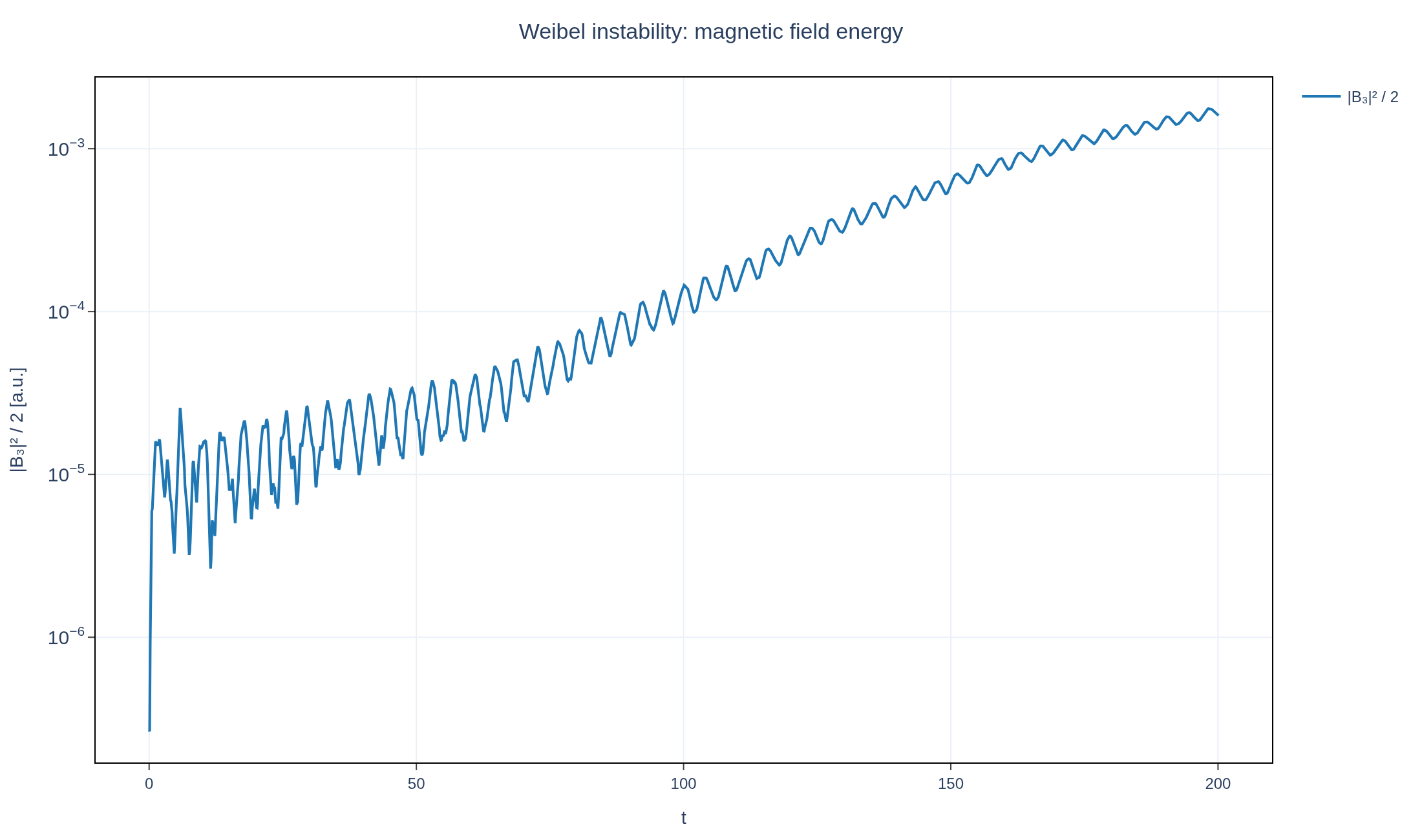
Loading interactive figure…
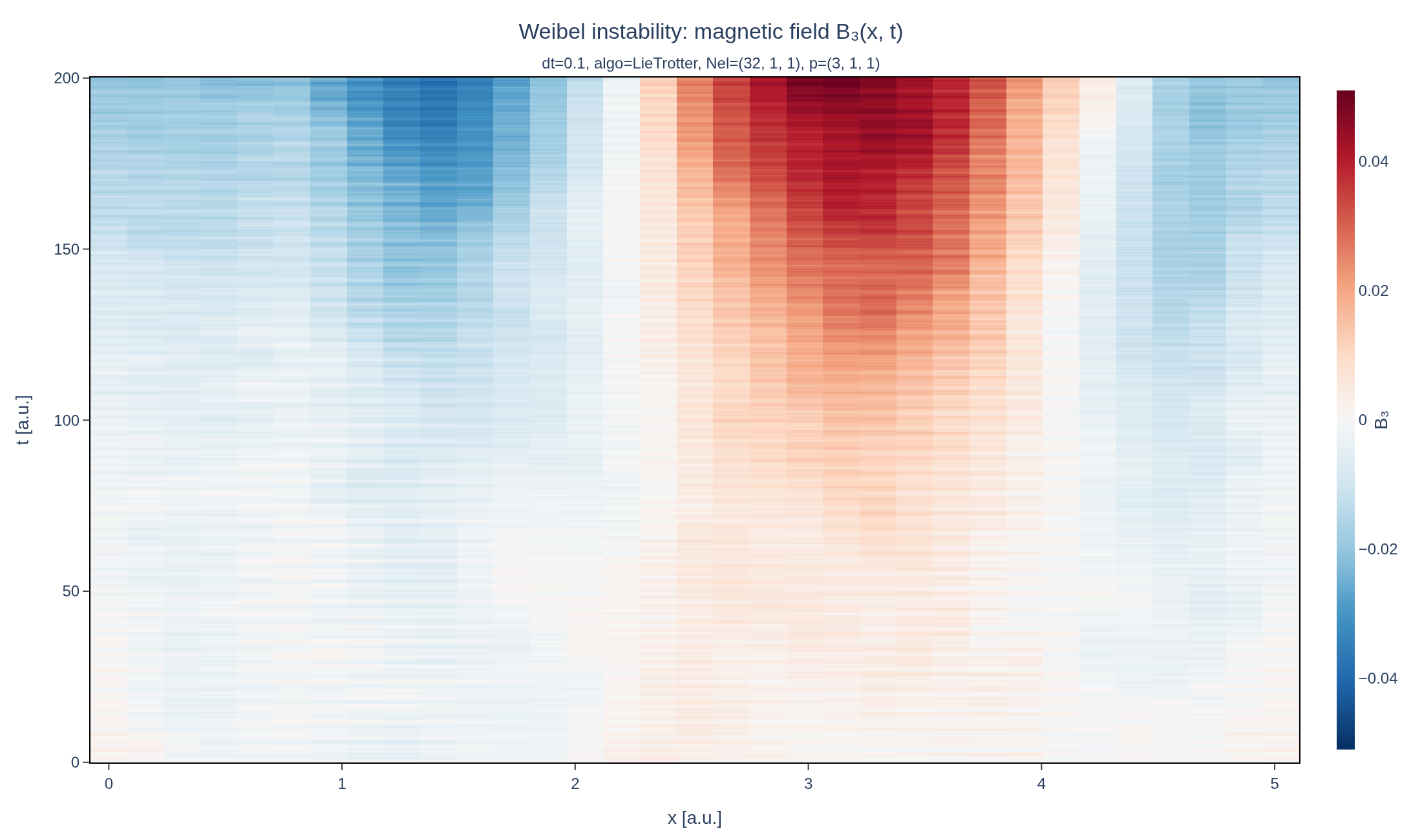
Loading interactive figure…
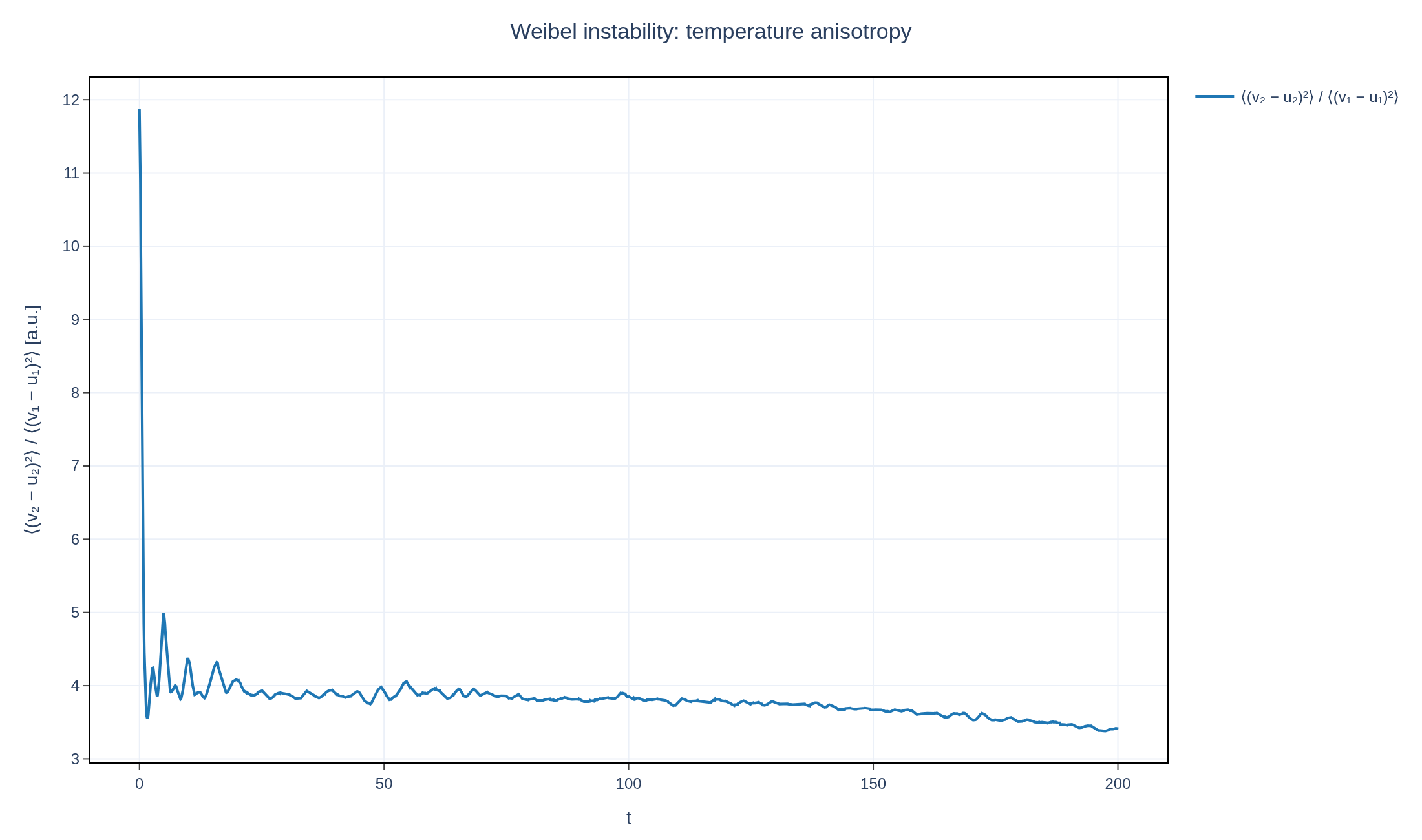
Physical problem
Spontaneous field generation from temperature anisotropy
PDEs solved by model:
Vlasov equation:
Ampère's law:
Faraday's law:
where and for electrons.
At initial time the weak Poisson equation is solved once to weakly satisfy Gauss' law,
Moreover, it is assumed that
where is the static equilibrium magnetic field.
Simulation geometry
Domain used in this run
The actual Cuboid geometry reconstructed from this run's metadata. Switch between the 3D view and physical-coordinate slices.
Domain
Cuboid
Mapping
Loading Cuboid…
Parameters
| Parameter | Value | Description |
|---|---|---|
| Loading parameters… | ||
Performance
Profiling
Struphy's built-in scope-profiler instruments every propagator, pusher and solver call — these are the real per-call timings from the run above.
Durations
Gantt (rank 0)
Region statistics
| Region | Count | Avg (s) | Min (s) | Max (s) | Total (s) |
|---|
Complete source
Simulation script
Run it locally
1. Install and compile
Use Python 3.10 or newer with Struphy's system prerequisites installed. Run these commands in your Python environment:
pip install "struphy[pproc]>=3.4.0"
pip install "plasma-plots[plotly]>=0.1.1"
struphy compile
PNG exports need Chrome or Chromium. If Chrome is not installed, run kaleido_get_chrome.
2. Run the script
Download the .py file above, open a terminal in its directory, then run:
python weibel-instability.pyFigures are saved in the current directory. Add --show to display them before saving.
"""Weibel instability: temperature anisotropy generates a magnetic field.

A plasma with a hotter perpendicular temperature than parallel temperature is
unstable to spontaneous magnetic field generation: small magnetic
perturbations grow exponentially, tapping the excess perpendicular thermal
energy, until they're strong enough to isotropize the distribution.

Adapted from Struphy's maintained example
(examples/VlasovMaxwellOneSpecies/weibel_instability), at reduced particle
count and run length to keep it a quick gallery run.

Install dependencies and compile the kernels (Python 3.10 or newer):

    pip install "struphy[pproc]>=3.4.0"
    pip install "plasma-plots[plotly]>=0.1.1"
    struphy compile

PNG exports require Chrome or Chromium. If Chrome is not installed, run:

    kaleido_get_chrome

Save this file and run it from the directory where you want the output:

    python weibel-instability.py

Figures are saved in the current directory; add --show to display them before saving.
"""

import argparse

import numpy as np

from struphy import (
    BinningPlot,
    BoundaryParameters,
    DerhamOptions,
    EnvironmentOptions,
    LoadingParameters,
    SavingParameters,
    Simulation,
    SortingParameters,
    Time,
    WeightsParameters,
    domains,
    grids,
    maxwellians,
    perturbations,
)
from struphy.models import VlasovMaxwellOneSpecies
from plasma_plots import save_figure

wavenumber = 1.25

# A colder parallel (vth1) than perpendicular (vth2) thermal spread -- the
# temperature anisotropy that Weibel feeds on.
vth1 = 0.02 / np.sqrt(2)
vth2 = vth1 * np.sqrt(12)

# A tiny seed perturbation in B_z, needed to trigger the (otherwise exact) instability.
magnetic_perturbation_amplitude = -1e-4


def create_simulation() -> Simulation:
    model = VlasovMaxwellOneSpecies(alpha=1.0, epsilon=-1.0, measure_gauss_law=True)
    model.em_fields.e_field.save_data = True
    domain = domains.Cuboid(r1=2 * np.pi / wavenumber)
    grid = grids.TensorProductGrid(num_elements=(32, 1, 1))
    derham_opts = DerhamOptions(degree=(3, 1, 1))
    time_opts = Time(dt=0.1, Tend=200.0, split_algo="LieTrotter")
    # A binned (v1, v2) distribution at every step, to follow the temperature anisotropy.
    velocity_bins = BinningPlot(slice="v1_v2", n_bins=(48, 48), ranges=((-0.12, 0.12), (-0.3, 0.3)))
    model.kinetic_ions.set_markers(
        loading_params=LoadingParameters(
            Np=20_000,
            set_zero_velocity=(False, False, True),
            moments=(0.0, 0.0, 0.0, vth1, vth2, 1.0),
            seed=1234,
        ),
        # The control-variate weighting violates Gauss's law for this setup, so it's disabled here.
        weights_params=WeightsParameters(control_variate=False),
        boundary_params=BoundaryParameters(),
        sorting_params=SortingParameters(boxes_per_dim=(16, 1, 1), do_sort=True),
        saving_params=SavingParameters(binning_plots=(velocity_bins,)),
        bufsize=2.0,
    )

    model.propagators.maxwell.options = model.propagators.maxwell.Options()
    model.propagators.push_eta.options = model.propagators.push_eta.Options()
    model.propagators.push_vxb.options = model.propagators.push_vxb.Options()
    model.propagators.coupling_va.options = model.propagators.coupling_va.Options()
    model.initial_poisson.options = model.initial_poisson.Options(stab_mat="M0")

    model.kinetic_ions.var.add_background(maxwellians.Maxwellian3D(vth1=(vth1, None), vth2=(vth2, None)))
    model.em_fields.b_field.add_perturbation(
        perturbations.ModesCos(amps=(magnetic_perturbation_amplitude,), ls=(1,), comp=2),
    )

    env = EnvironmentOptions(
        out_folders="struphy_gallery_runs",
        sim_folder="weibel_instability",
    )
    sim = Simulation(
        model=model,
        name="Weibel instability",
        description=(
            "A temperature-anisotropic plasma spontaneously generates a magnetic "
            "field: a tiny seed perturbation grows exponentially, tapping the "
            "excess perpendicular thermal energy."
            r" The initial thermal speeds satisfy $$v_{\mathrm{th},x}=0.02/\sqrt{2},\qquad v_{\mathrm{th},y}=\sqrt{12}\,v_{\mathrm{th},x},$$"
            r" giving :math:`T_y/T_x=12`. A cosine seed in the third magnetic component has amplitude :math:`-10^{-4}` and wavenumber :math:`k=1.25`."
        ),
        env=env,
        time_opts=time_opts,
        domain=domain,
        grid=grid,
        derham_opts=derham_opts,
    )
    return sim


def pproc(sim: Simulation, show: bool = False):
    domain = sim.domain

    output = sim.output.pproc(create_vtk=False)

    # Total magnetic (B3) field energy at each saved time, summed over the grid.
    b_field = output.fields.em_fields.b_field
    grid_shape = tuple(b_field.sizes[dim] for dim in ("eta1", "eta2", "eta3"))
    cell_volume = float(np.prod([1.0 / max(n - 1, 1) for n in grid_shape]))
    magnetic_energy = (b_field.isel(component=2) ** 2).sum(("eta1", "eta2", "eta3")) * cell_volume / 2
    magnetic_energy.attrs = {"label": "|B₃|² / 2"}
    time = np.asarray(magnetic_energy.t)

    # Fit the growth rate over the clean exponential window (roughly the
    # middle third of the run, before saturation).
    growth_window = (time > time[-1] / 5) & (time < 2 * time[-1] / 5)
    growth_rate = float(np.polyfit(time[growth_window], np.log(magnetic_energy.values[growth_window]), 1)[0] / 2)
    print(f"Measured growth rate (in |B3|, from the energy fit): {growth_rate:.5f}")

    figure = magnetic_energy.plasma.plot.timeseries(
        logy=True,
        title="Weibel instability: magnetic field energy",
        backend="plotly",
    )

    save_figure(figure, "weibel-instability", show=show)

    # The magnetic field along x, over time.
    magnetic_field = b_field.isel(component=2, eta2=0, eta3=0)  # (t, e1)
    space_time = magnetic_field.assign_coords(eta1=magnetic_field.eta1.values * domain.params["r1"]).plasma.plot.slice(
        x="eta1",
        y="t",
        symmetric=True,
        cmap="RdBu_r",
        title="Weibel instability: magnetic field B₃(x, t)",
        xlabel="x [a.u.]",
        ylabel="t [a.u.]",
        colorbar_label="B₃",
        backend="plotly",
    )

    # The temperature anisotropy from the binned (v1, v2) distribution: the ratio of the velocity
    # variances, which the instability reduces by heating the cold direction.
    f = output.evaluate("kinetic_ions/v1_v2_density/f")  # (t, v1, v2)
    moments = f.plasma.analysis.velocity_moments()
    anisotropy = moments.variance_v2 / moments.variance_v1
    anisotropy.attrs = {"label": "⟨(v₂ − u₂)²⟩ / ⟨(v₁ − u₁)²⟩"}
    anisotropy_figure = anisotropy.plasma.plot.timeseries(
        logy=False,
        title="Weibel instability: temperature anisotropy",
        backend="plotly",
    )

    save_figure(space_time, "weibel-instability-space-time", show=show)
    save_figure(anisotropy_figure, "weibel-instability-anisotropy", show=show)


if __name__ == "__main__":
    argparser = argparse.ArgumentParser(description="Run the weibel instability example.")
    argparser.add_argument(
        "--pproc-only",
        action="store_true",
        help="Run post-processing on an existing simulation instead of running a new one.",
    )
    argparser.add_argument("--show", action="store_true", help="Show the figures before saving them.")
    args = argparser.parse_args()

    simulation = create_simulation()
    if not args.pproc_only:
        simulation.run()
    pproc(simulation, show=args.show)
See the post-processing guide for more ways to inspect the result.