Hybrid model
LinearMHDVlasovCC
Hybrid linear MHD coupled with energetic ions (6D Vlasov) via the current-coupling scheme.
Overview
LinearMHDVlasovCC is a current-coupling hybrid model for small
perturbations around an MHD equilibrium. It is intended for energetic particle effects on linear MHD waves and instabilities without the cost of a fully kinetic background plasma.
Use cases
This model is appropriate for:
- linear energetic-particle coupling to MHD modes
- current-coupling hybrid verification
- reduced-cost studies of fast-ion effects on wave propagation
Governing equations
PDEs solved by model:
MHD continuity:
MHD momentum:
MHD pressure:
MHD induction:
Energetic-particle Vlasov equation:
Energetic-particle moments:
where .
Normalization
Both fluid and particle velocities are normalized with the Alfvén
speed,
The hot-species cyclotron parameter is .
Discretization
Time integration is performed by the following propagators (in sequence):
Diagnostics
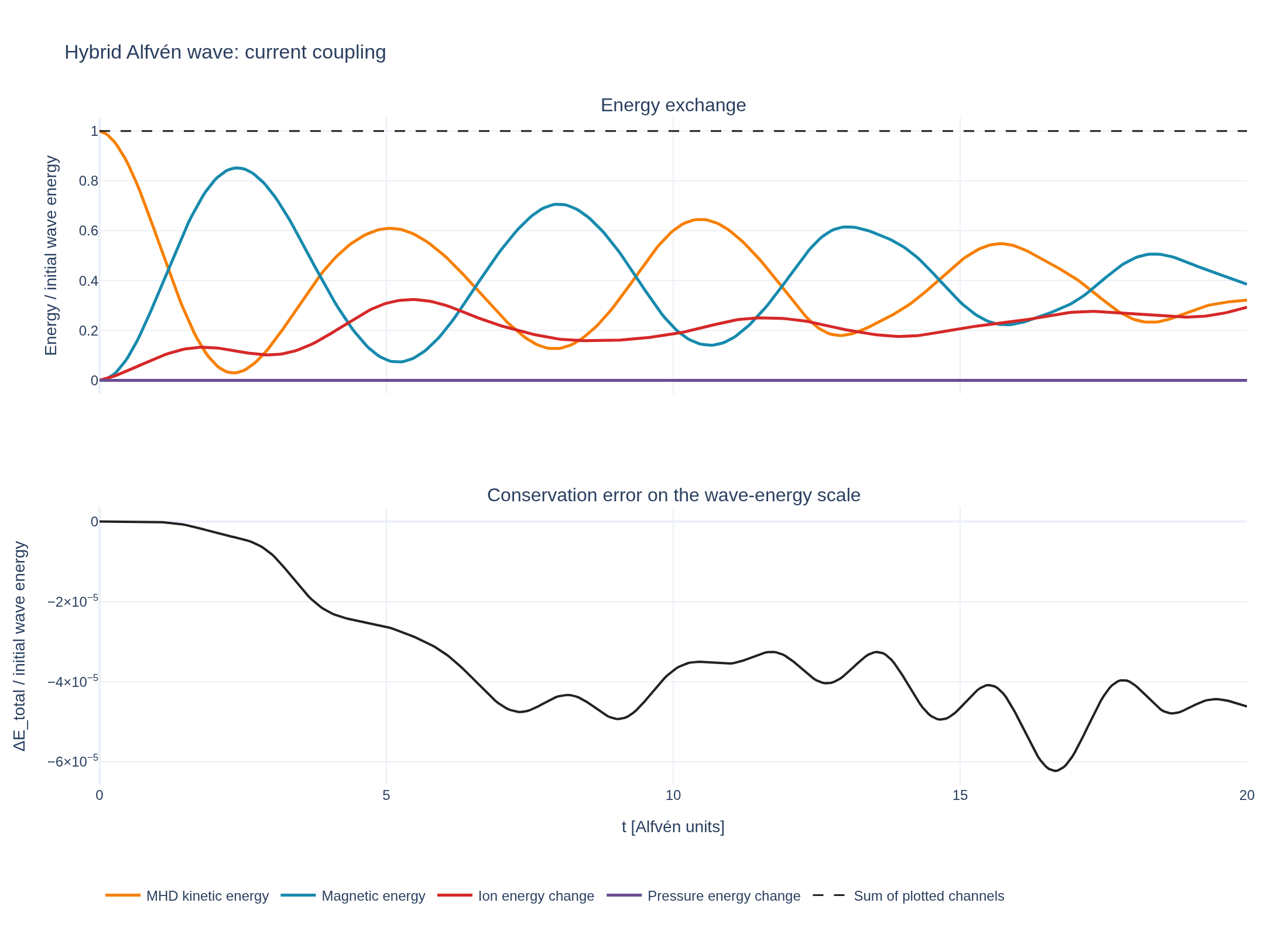
The following scalars are tracked during simulation:
- MHD kinetic energy:
en_U - Thermal pressure energy:
en_p - Magnetic energy:
en_B - Energetic-particle energy:
en_f - Total energy:
en_tot - Lost particles:
n_lost_particles