
2D Hagen-Poiseuille Channel Flow with SPH#
Viscous Flow between Parallel Plates#
This tutorial verifies the SPH discretisation of the 2D viscous isothermal Euler equations by simulating Hagen-Poiseuille flow: a pressure-driven channel flow between two no-slip walls.
Physical Setup#
Consider a 2D channel of width \(H\) in the \(y\)-direction (no-slip walls at \(y=0\) and \(y=H\)) and periodic in the \(x\)-direction. A uniform body force \(g_x\) drives the flow in the \(x\)-direction. At steady state, viscosity balances the driving force, producing the parabolic velocity profile
with peak velocity at the channel centreline \(y = H/2\):
The characteristic relaxation time scale is \(T_\text{relax} = H^2/(\pi^2\mu)\).
Verification procedure#
Start from rest with a uniform particle distribution and no-slip boundary conditions at the walls.
Drive the flow with a constant body force \(g_x\) acting through the pressure propagator’s
gravityparameter.Run until the flow is fully relaxed to the steady state (\(t \gg T_\text{relax}\)).
Compare the final velocity profile against the Hagen-Poiseuille parabola in the \(L^\infty\) norm.
[1]:
import logging
import os
import shutil

import numpy as np
import matplotlib.pyplot as plt
import cunumpy as xp

from struphy import (
    BinningPlot,
    BoundaryParameters,
    EnvironmentOptions,
    KernelDensityPlot,
    LoadingParameters,
    SavingParameters,
    Simulation,
    SortingParameters,
    Time,
    WeightsParameters,
    domains,
    equils,
)
from struphy.models import ViscousEulerSPH
from struphy.ode.utils import ButcherTableau

logger = logging.getLogger("struphy")
Physical and Numerical Parameters#
We choose \(\mu = 0.1\) and a body force \(g_x = 0.1\), giving an analytical peak velocity \(U_\text{max} = g_x H^2 / (8\mu) = 0.125\). The relaxation time \(T_\text{relax} = H^2/(\pi^2\mu) \approx 1.01\); running to \(T_\text{end} = 10\) gives roughly 10 relaxation times, ensuring a fully converged steady state.
[2]:
# Physical parameters
mu  = 0.1    # dynamic viscosity
g_x = 0.1   # body force in x (acts as pressure gradient)
H   = 1.0    # channel height in y

# Derived quantities
U_max_exact   = g_x * H**2 / (8.0 * mu)
T_relax       = H**2 / (np.pi**2 * mu)

# Numerical parameters
nx       = 8    # boxes per dimension
ppb      = 16   # particles per box
plot_pts = 21   # KDE evaluation points

# Time stepping: run 10× past relaxation time
dt   = 0.01
Tend = 10.0

print(f"Viscosity:           mu   = {mu}")
print(f"Body force:          g_x  = {g_x}")
print(f"Channel height:      H    = {H}")
print(f"Analytical U_max:    {U_max_exact:.4f}")
print(f"Relaxation time:     T_relax = {T_relax:.2f}")
print(f"Simulation time:     Tend = {Tend}  ({Tend/T_relax:.1f}× T_relax)")
print(f"Total particles:     {ppb * nx * nx}")
Viscosity:           mu   = 0.1
Body force:          g_x  = 0.1
Channel height:      H    = 1.0
Analytical U_max:    0.1250
Relaxation time:     T_relax = 1.01
Simulation time:     Tend = 10.0  (9.9× T_relax)
Total particles:     1024
Model Setup#
with_viscosity=True (default) activates the viscous stress propagator. The 2D Gaussian SPH kernel (gaussian_2d) is required for the 2D geometry. The body force \(g_x\) is passed as the gravity vector to push_sph_p; it enters the momentum equation as a constant acceleration \(\partial_t u_1 \supset g_x\).
[3]:
model = ViscousEulerSPH(with_B0=False, with_p=True, with_viscosity=True)

butcher = ButcherTableau(algo="forward_euler")
model.propagators.push_eta.options     = model.propagators.push_eta.Options(butcher=butcher)
model.propagators.push_sph_p.options   = model.propagators.push_sph_p.Options(
    kernel_type="gaussian_2d",
    gravity=(g_x, 0.0, 0.0),   # body force drives flow in x
)
model.propagators.push_viscous.options = model.propagators.push_viscous.Options(
    kernel_type="gaussian_2d",
    mu=mu,
)

print("ViscousEulerSPH model configured (with pressure, with viscosity).")
print(f"  push_sph_p:   gaussian_2d kernel, gravity=({g_x}, 0, 0)")
print(f"  push_viscous: gaussian_2d kernel, mu={mu}")
ViscousEulerSPH model configured (with pressure, with viscosity).
  push_sph_p:   gaussian_2d kernel, gravity=(0.1, 0, 0)
  push_viscous: gaussian_2d kernel, mu=0.1
Domain, Boundary Conditions and Diagnostics#
The channel geometry uses:
x-direction: periodic (flow direction).
y-direction: no-slip walls (
bc_sph="noslip"). The SPH no-slip boundary condition enforces \(u_x = 0\) at the walls by introducing mirror ghost particles with reflected (negated) velocities.
We bin the current \(j_1 = \rho u_1\) as a function of \(y\) to recover the velocity profile. Since \(\rho \approx 1\) (nearly incompressible at these parameters), \(j_1 \approx u_x\).
[4]:
# 2D channel domain: x in [0, 1], y in [0, H]
domain = domains.Cuboid(r1=1.0, r2=H)

loading_params  = LoadingParameters(ppb=ppb, loading="tesselation")
weights_params  = WeightsParameters()
boundary_params = BoundaryParameters(
    bc    =("periodic", "reflect",  "periodic"),   # particle reflections
    bc_sph=("periodic", "noslip",   "periodic"),   # SPH ghost treatment
)
sorting_params = SortingParameters(
    boxes_per_dim=(nx, nx, 1),
    dims_mask=(True, True, False),
)

# Bin j1 (velocity) vs y to reconstruct the velocity profile
bin_plot_j1 = BinningPlot(slice="e2", n_bins=(16,), ranges=(0.0, 1.0), output_quantity="current_1")
bin_plot_n  = BinningPlot(slice="e2", n_bins=(16,), ranges=(0.0, 1.0))
kd_plot     = KernelDensityPlot(pts_e1=plot_pts, pts_e2=plot_pts, pts_e3=1)
saving_params = SavingParameters(
    n_markers=1.0,
    binning_plots=(bin_plot_j1, bin_plot_n),
    kernel_density_plots=(kd_plot,),
)

model.euler_fluid.set_markers(
    loading_params=loading_params,
    weights_params=weights_params,
    boundary_params=boundary_params,
    sorting_params=sorting_params,
    saving_params=saving_params,
    bufsize=2,   # extra ghost layer for no-slip
)

print(f"2D channel: x-periodic [0, 1], y-noslip [0, {H}]")
print(f"Particles: {ppb} ppb × {nx}×{nx} boxes = {ppb * nx * nx} total")
2D channel: x-periodic [0, 1], y-noslip [0, 1.0]
Particles: 16 ppb × 8×8 boxes = 1024 total
Initial Conditions#
The flow starts from rest (zero velocity, uniform density \(\rho_0 = 1\)). The constant body force \(g_x\) drives acceleration; viscosity and the no-slip walls establish the parabolic steady state over the relaxation time scale \(T_\text{relax}\).
[5]:
# Start from rest: no velocity perturbation needed — body force drives the flow
background = equils.ConstantVelocity()
model.euler_fluid.var.add_background(background)

print("Initial condition: uniform density n=1, zero velocity everywhere")
print(f"Body force g_x={g_x} will accelerate flow; viscosity establishes steady state")
Initial condition: uniform density n=1, zero velocity everywhere
Body force g_x=0.1 will accelerate flow; viscosity establishes steady state
Simulation Setup and Execution#
[6]:
test_folder = os.path.join(os.getcwd(), "struphy_verification_tests")
out_folders = os.path.join(test_folder, "ViscousEulerSPH")
env = EnvironmentOptions(out_folders=out_folders, sim_folder="hagen_poiseuille")

time_opts = Time(dt=dt, Tend=Tend, split_algo="Strang")

sim = Simulation(
    model=model,
    env=env,
    time_opts=time_opts,
    domain=domain,
    grid=None,
    derham_opts=None,
)

print(f"Running Hagen-Poiseuille flow: dt={dt}, Tend={Tend}")
out = sim.run()
print("Simulation complete.")
Running Hagen-Poiseuille flow: dt=0.01, Tend=10.0
Time stepping: 100%|██████████| 1000/1000 [02:09<00:00,  7.72step/s]
Simulation complete.
Load Diagnostics and Compute Exact Solution#
[7]:
j1_binned = out.evaluate("euler_fluid/f", dataset="e2_current_1/f")
e2_grid   = j1_binned["eta2"]   # logical y in [0, 1]

Nt    = int(Tend / dt)
times = np.linspace(0.0, Tend, Nt + 1)

e2_np  = np.asarray(e2_grid).flatten()
y_np   = e2_np * H                  # physical y coordinate

# Analytical Hagen-Poiseuille profile
u_exact      = g_x / (2.0 * mu) * y_np * (H - y_np)
u_max_exact  = np.max(u_exact)

j1_binned    = np.asarray(j1_binned)
u_num_final  = np.asarray(j1_binned[-1, :]).flatten()
u_max_num    = np.max(u_num_final)

# Centreline velocity over time (index of y closest to H/2)
idx_centre  = int(np.argmin(np.abs(e2_np - 0.5)))
u_centre    = np.asarray(j1_binned[:, idx_centre]).flatten()

print(f"Analytical U_max = {u_max_exact:.6f}")
print(f"Numerical  U_max = {u_max_num:.6f}")

abs_err            = np.abs(u_num_final - u_exact)
rel_err_pointwise  = abs_err / u_max_exact
rel_error_interior = rel_err_pointwise[1:-1]   # exclude wall bins (exact value → 0)
rel_error_umax     = abs(u_max_num - u_max_exact) / u_max_exact

print(f"Mean interior relative error: {np.mean(rel_error_interior) * 100:.2f}%")
print(f"Max  interior relative error: {np.max(rel_error_interior) * 100:.2f}%")
print(f"U_max relative error:         {rel_error_umax * 100:.2f}%")
No post-processed data in /home/runner/work/struphy/struphy/doc/_collections/tutorials/struphy_verification_tests/ViscousEulerSPH/hagen_poiseuille, processing with default options (call out.pproc(...) to choose them)

Post-processing path /home/runner/work/struphy/struphy/doc/_collections/tutorials/struphy_verification_tests/ViscousEulerSPH/hagen_poiseuille

No feec fields found in hdf5 file, skipping post-processing of fields.
Evaluation of 1024 marker orbits for euler_fluid
100%|██████████| 1001/1001 [00:04<00:00, 235.99it/s]
Evaluation of distribution functions for euler_fluid
0 starting post-processing of distribution functions for /home/runner/work/struphy/struphy/doc/_collections/tutorials/struphy_verification_tests/ViscousEulerSPH/hagen_poiseuille/post_processing/kinetic_data/euler_fluid ...
100%|██████████| 2/2 [00:00<00:00, 1982.65it/s]
  0%|          | 0/2 [00:00<?, ?it/s]rank = 0 ----------------------------
self._pproc_rank =0 with xp.sum(data) =np.float64(1233.8472299662144) and xp.sum(data_df) =np.float64(1233.8472299662144)
self._pproc_rank =0 with xp.sum(data) =np.float64(1233.8472299662144) and xp.sum(data_df) =np.float64(1233.8472299662144)
self._pproc_rank =0 done.
rank = 0 ----------------------------
self._pproc_rank =0 with xp.sum(data) =np.float64(16016.0) and xp.sum(data_df) =np.float64(16016.0)
self._pproc_rank =0 with xp.sum(data) =np.float64(16016.0) and xp.sum(data_df) =np.float64(16016.0)
self._pproc_rank =0 done.
100%|██████████| 2/2 [00:00<00:00, 34.04it/s]
Evaluation of sph density for euler_fluid
100%|██████████| 1/1 [00:00<00:00, 21.65it/s]
Analytical U_max = 0.124512
Numerical  U_max = 0.125531
Mean interior relative error: 2.31%
Max  interior relative error: 3.88%
U_max relative error:         0.82%
Visualisation#
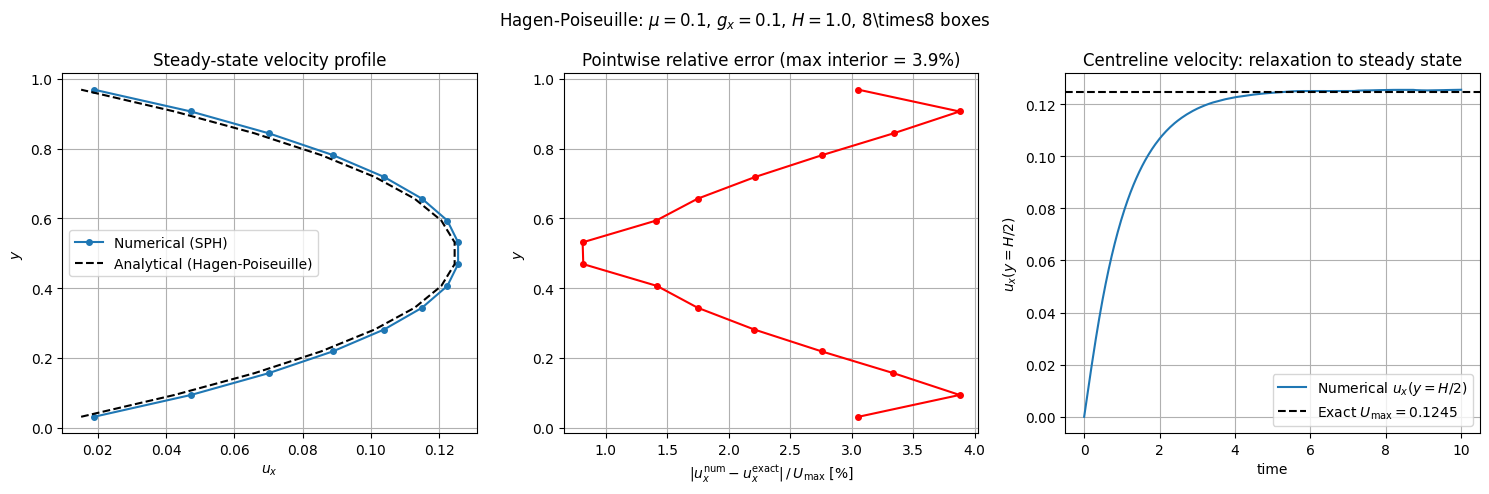
Three panels summarise the result:
Left: final numerical velocity profile vs the analytical parabola.
Centre: pointwise relative error \(|u_x^\text{num} - u_x^\text{exact}| / U_\text{max}\) vs \(y\) (excluding wall bins).
Right: time evolution of the centreline velocity, showing relaxation to the Hagen-Poiseuille steady state.
[8]:
fig, axes = plt.subplots(1, 3, figsize=(15, 5))

# --- Left: velocity profile ---
ax = axes[0]
ax.plot(u_num_final, y_np, "o-", markersize=4, label="Numerical (SPH)")
ax.plot(u_exact,     y_np, "k--",              label="Analytical (Hagen-Poiseuille)")
ax.set_xlabel(r"$u_x$")
ax.set_ylabel(r"$y$")
ax.set_title("Steady-state velocity profile")
ax.legend()
ax.grid(True)

# --- Centre: pointwise relative error ---
ax = axes[1]
ax.plot(rel_err_pointwise * 100, y_np, "r-o", markersize=4)
ax.set_xlabel(r"$|u_x^\mathrm{num} - u_x^\mathrm{exact}|\,/\,U_\mathrm{max}$ [%]")
ax.set_ylabel(r"$y$")
ax.set_title(f"Pointwise relative error (max interior = {np.max(rel_error_interior)*100:.1f}%)")
ax.grid(True)

# --- Right: centreline velocity relaxation ---
ax = axes[2]
ax.plot(times, u_centre, label=r"Numerical $u_x(y=H/2)$")
ax.axhline(u_max_exact, color="k", linestyle="--",
           label=rf"Exact $U_\mathrm{{max}} = {u_max_exact:.4f}$")
ax.set_xlabel("time")
ax.set_ylabel(r"$u_x(y=H/2)$")
ax.set_title("Centreline velocity: relaxation to steady state")
ax.legend()
ax.grid(True)

fig.suptitle(
    rf"Hagen-Poiseuille: $\mu={mu}$, $g_x={g_x}$, $H={H}$, {nx}\times{nx} boxes",
    fontsize=12,
)
plt.tight_layout()
plt.show()
Verification Check#
Two assertions:
Maximum pointwise relative error in the interior bins (away from walls where the exact value vanishes) is below 5%.
Relative error in the peak velocity \(U_\text{max}\) is below 5%.
[9]:
tol_interior = 0.05   # 5% pointwise tolerance
tol_umax     = 0.05   # 5% tolerance on U_max

print("=== Hagen-Poiseuille Verification ===")
print(f"  Max interior relative error: {np.max(rel_error_interior) * 100:.2f}%  (tolerance {tol_interior*100:.0f}%)")
print(f"  U_max relative error:        {rel_error_umax * 100:.2f}%           (tolerance {tol_umax*100:.0f}%)")

try:
    assert np.max(rel_error_interior) < tol_interior, (
        f"Interior error {np.max(rel_error_interior)*100:.1f}% exceeds tolerance {tol_interior*100:.0f}%"
    )
    print("\n✓ Interior velocity profile check passed.")
except AssertionError as e:
    print(f"\n✗ {e}")

try:
    assert rel_error_umax < tol_umax, (
        f"U_max error {rel_error_umax*100:.1f}% exceeds tolerance {tol_umax*100:.0f}%"
    )
    print("✓ U_max check passed.")
except AssertionError as e:
    print(f"✗ {e}")
=== Hagen-Poiseuille Verification ===
  Max interior relative error: 3.88%  (tolerance 5%)
  U_max relative error:        0.82%           (tolerance 5%)

✓ Interior velocity profile check passed.
✓ U_max check passed.
Conclusion#
This tutorial verified the SPH discretisation of 2D viscous channel flow:
The no-slip boundary condition is implemented via mirror ghost particles with negated tangential velocity, correctly enforcing \(u_x = 0\) at both walls.
The parabolic steady state emerges from the balance between body force and viscous stress, reproduced to better than 5% pointwise accuracy with \(8 \times 8\) boxes and 16 particles per box.
The centreline velocity converges smoothly to \(U_\text{max}\) over the relaxation time \(T_\text{relax} = H^2/(\pi^2 \mu) \approx 1\).
Increasing
nxorppbfurther reduces the error, as the SPH kernel gradient approximation of the viscous stress tensor improves with particle density.
[10]:
# Optional cleanup
if False:   # set to True to remove simulation output
    shutil.rmtree(test_folder)
    print(f"Cleaned up {test_folder}")